
Quick Answer
If you’re choosing between Yoto or Tonie, the best option depends on your child’s age and how they like to interact with audio content.
- Yoto is ideal for older children because it offers educational content, music, podcasts, a digital library, and customizable cards.
- Tonie is better for younger children thanks to its soft character figurines, simple controls, and toddler-friendly design.
Neither player is universally better—the right choice depends on your child’s needs.
What Is Yoto?
Overview
Yoto is a screen-free audio player that uses physical audio cards to play stories, music, educational lessons, sleep sounds, podcasts, and radio stations.
Parents appreciate Yoto because it grows with children over many years, offering content that ranges from bedtime stories for preschoolers to educational podcasts for older kids.
How Yoto Works
Simply insert a Yoto Card into the player.
The player automatically recognizes the card and begins playing its stored content. Parents can also create personalized cards containing their own recordings, playlists, or purchased audio.
Best Features
- Physical audio cards
- Daily educational podcast
- Built-in radio stations
- White noise and sleep sounds
- Alarm clock
- Bluetooth speaker mode
- Parent mobile app
- Make Your Own cards
- Pixel display without a touchscreen
Pros
- Excellent educational library
- Suitable for ages 3–12+
- Custom audio creation
- Growing content ecosystem
- Encourages independent listening
Cons
- Slightly more complex for toddlers
- Cards are smaller than Tonie figurines
- Some premium content requires additional purchases
Examples
Example 1
A six-year-old inserts a card about dinosaurs before bedtime.
Result: They listen independently without needing a phone.
Example 2
Parents record bedtime messages on a custom card.
Result: Children can replay familiar voices whenever they like.
Key Insight
Yoto focuses on long-term learning, independence, and expanding content rather than toys.
What Is Tonie?
Overview
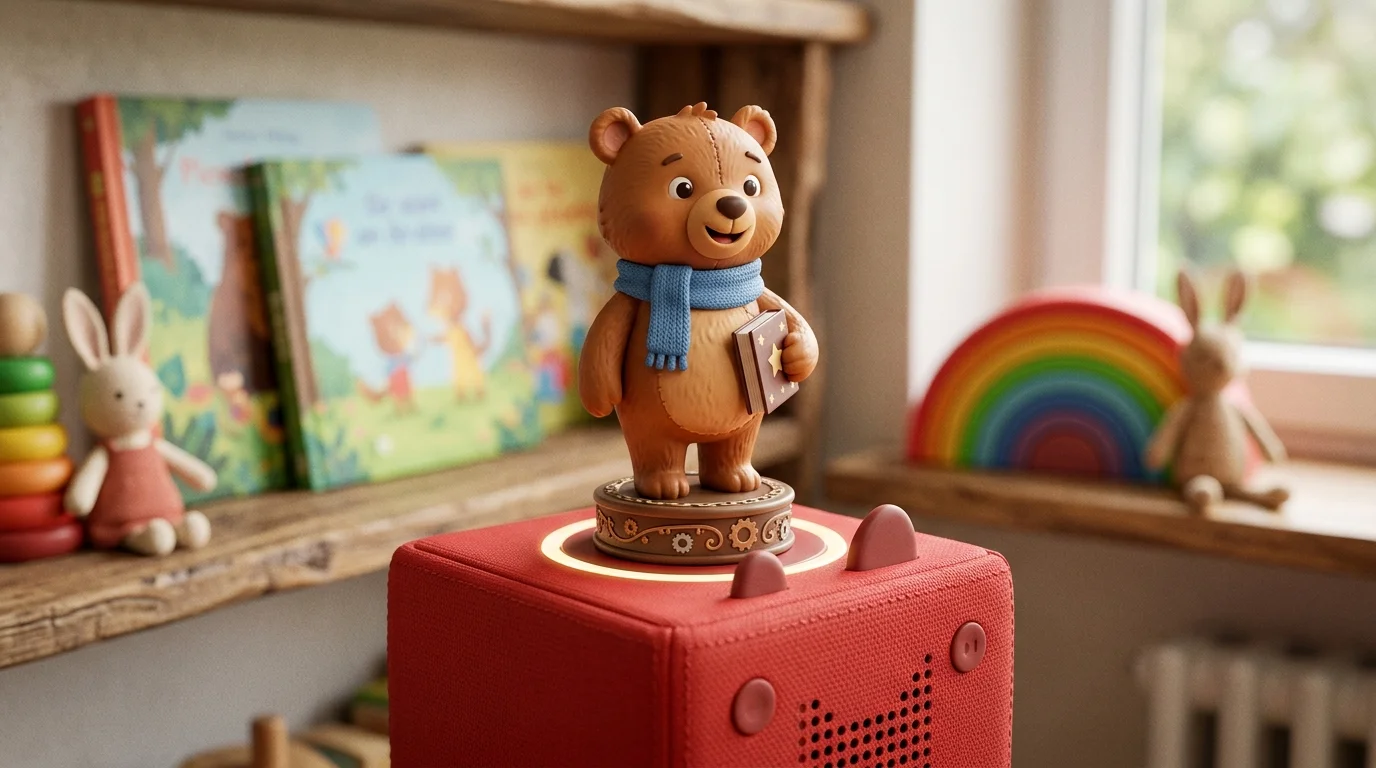
Tonie is another screen-free audio player, but instead of cards, it uses collectible character figurines called Tonies.
Children simply place a figurine on top of the Toniebox to begin listening.
How Tonie Works
Each Tonie character contains licensed stories, songs, or educational content.
The figurine magnetically attaches to the speaker, making it easy for even very young children to operate independently.
Best Features
- Soft padded design
- Character figurines
- Extremely simple controls
- Durable construction
- Creative Tonies for custom recordings
- Child-friendly volume controls
Pros
- Perfect for toddlers
- Easy to understand
- Highly durable
- Fun collectible characters
- Great tactile experience
Cons
- Content depends on figurines
- Can become expensive when buying many characters
- Less educational variety for older children
Examples
Example 1
A three-year-old places an Elsa figurine on the Toniebox.
Result: Songs and stories begin instantly.
Example 2
A grandparent records a bedtime story using a Creative Tonie.
Result: The child hears a familiar voice every night.
Key Insight
Tonie emphasizes imaginative play through collectible characters rather than an expanding educational platform.
Yoto or Tonie: Key Differences
Main Differences
- Yoto uses audio cards, while Tonie uses character figurines.
- Yoto targets broader age ranges.
- Tonie is designed primarily for toddlers and preschoolers.
- Yoto offers more educational content.
- Tonie offers stronger toy-like interaction.
- Yoto includes podcasts and radio.
- Tonie focuses mainly on stories and songs.
- Yoto grows with children longer.
- Tonie is easier for very young kids to operate.
Comparison Table
| Feature | Yoto | Tonie |
|---|---|---|
| Content Format | Audio Cards | Character Figurines |
| Best Age | 3–12+ years | 2–7 years |
| Learning Content | Extensive | Moderate |
| Stories | Excellent | Excellent |
| Music | Excellent | Excellent |
| Podcasts | Yes | Limited |
| Radio | Yes | No |
| Custom Audio | Make Your Own Cards | Creative Tonies |
| Ease of Use | Very Easy | Extremely Easy |
| Collectibility | Low | High |
| Parent Controls | Comprehensive | Good |
| Long-Term Value | Excellent | Good |
| Durability | Very Good | Excellent |
Real-World Usage Scenarios
Scenario 1: Toddler
Parent: “Which player can my two-year-old use alone?”
Answer: Tonie.
The figurines are large, durable, and easy to place.
🎯 Lesson: Tonie is usually the better choice for toddlers.
Scenario 2: School-Age Child
Parent: “My seven-year-old enjoys learning science.”
Answer: Yoto.
Its educational cards, podcasts, and learning content offer more variety.
🎯 Lesson: Yoto supports learning beyond entertainment.
Scenario 3: Frequent Travelers
Parent: “Which player is easier for road trips?”
Answer:
Both travel well, but Yoto’s compact cards take up much less space than multiple figurines.
🎯 Lesson: Yoto is more portable for families with many titles.
Scenario 4: Children Who Love Toys
Child: “I want my favorite characters.”
Answer:
Tonie provides recognizable figurines from popular franchises that also function as toys.
🎯 Lesson: Tonie combines playtime with storytelling.
Scenario 5: Long-Term Investment
Parent: “Which player will my child outgrow later?”
Answer:
Most children continue using Yoto for more years because of its wider range of age-appropriate content.
🎯 Lesson: Yoto generally offers greater longevity.
Common Mistakes
Thinking They’re the Same Product
Many shoppers assume the only difference is cards versus figurines.
Correction: Their content libraries, target ages, and learning experiences are significantly different.
Buying Based Only on Price
The player itself is only part of the total cost.
Why it happens: Families often forget they’ll likely purchase additional cards or figurines over time.
Ignoring Your Child’s Age
A toddler and a nine-year-old have very different needs.
Correction: Match the player to your child’s developmental stage instead of choosing based on popularity.
Overlooking Content Preferences
Some children love educational audio, while others prefer familiar characters and songs.
Correction: Browse each platform’s available content before making a decision.
Memory Tricks
Remember “Y” for Yoto
Y = Years of learning
Yoto is designed to grow with children over several years.
Remember “T” for Tonie
T = Toys
Tonie revolves around collectible character figurines that children can hold and play with.
Easy Shortcut
- Learning = Yoto
- Playful characters = Tonie
Expert Insight
Both Yoto and Tonie belong to the growing category of screen-free children’s audio players, but they prioritize different experiences.
Yoto has evolved into a broader educational platform with podcasts, radio, creative cards, and content for older children, making it a long-term learning companion.
Tonie, meanwhile, focuses on tactile interaction, storytelling, and simplicity. Its collectible figurines create a playful experience that is especially appealing to toddlers and preschoolers.
From a child development perspective, both products encourage independent listening, improve imagination, reduce screen time, and support language development. The deciding factor is less about which product is objectively better and more about which aligns with your child’s age, interests, and learning style. yoto or tonie.