
QUICK ANSWER
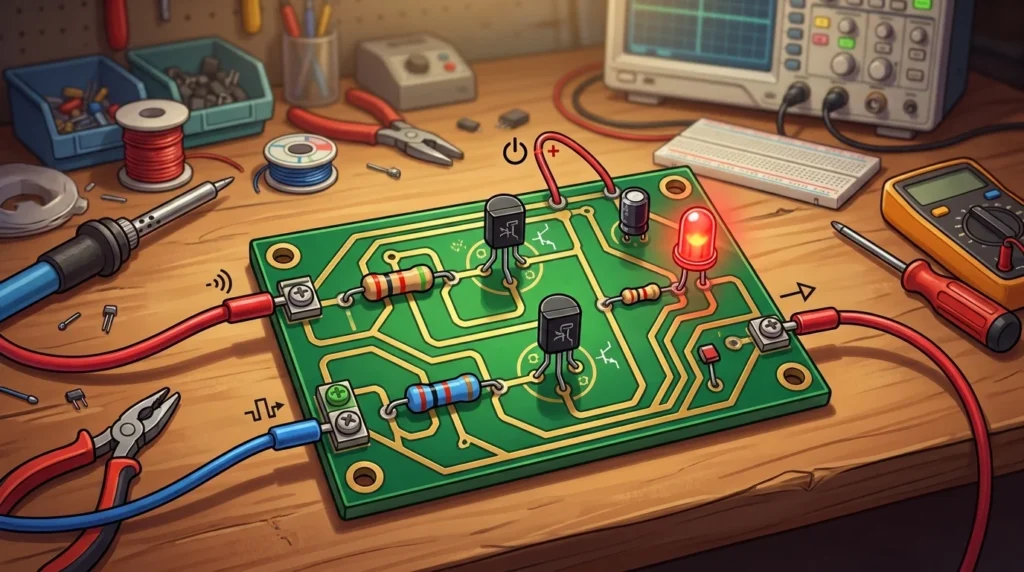
A transistor is a physical electronic switch used to control current, while a logic gate is a digital circuit that performs logical operations (AND, OR, NOT) using transistors.
👉 In simple terms:
- Transistor = hardware switch
- Logic gate = logic function built from transistors
DEEP EXPLANATION: TRANSISTOR
Definition
A transistor is a semiconductor device that acts as an electronic switch or amplifier, controlling the flow of electrical current.
Usage Rules
- Used as ON/OFF switch in digital circuits
- Found in CPUs, memory, and microchips
- Can also amplify signals (analog use)
Context (Electronics & Computing)
Transistors are the building blocks of all modern electronics, from smartphones to supercomputers.
Real Examples
- “CPU contains billions of transistors.”
- “Transistor switches represent binary 0 and 1.”
- “Small voltage controls large current in transistor.”
Key Insight
A transistor itself does NOT perform logic — it only switches current.

DEEP EXPLANATION: LOGIC GATE
Definition
A logic gate is a digital circuit that performs a specific logical function (AND, OR, NOT, NAND, NOR, XOR) based on binary inputs.
Usage Rules
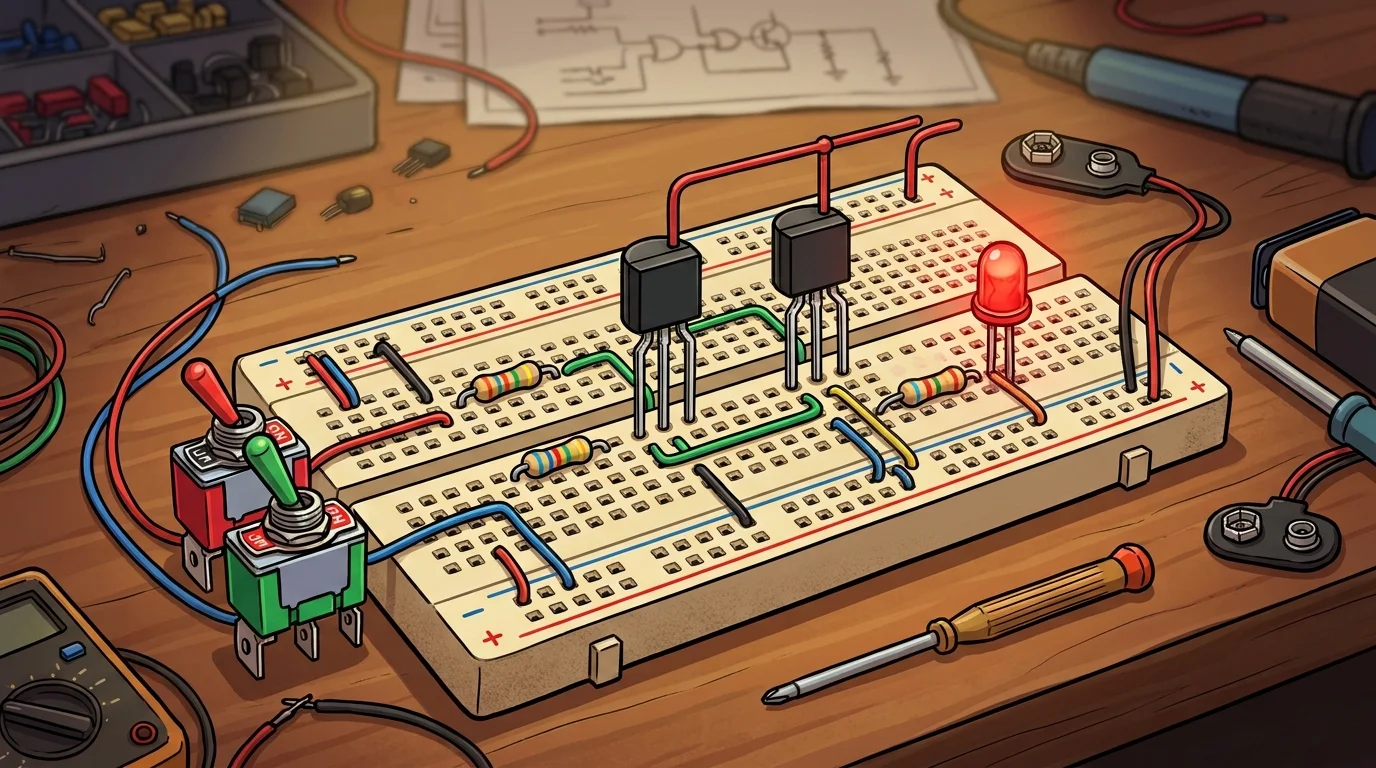
- Built using multiple transistors
- Works with binary inputs (0 and 1)
- Forms the foundation of digital systems
Context (Computer Architecture)
Logic gates are used in processors, arithmetic circuits, memory control, and decision-making systems.
Real Examples
- AND gate: outputs 1 only if both inputs are 1
- OR gate: outputs 1 if any input is 1
- NOT gate: inverts input
Key Insight
Logic gates are designed behaviors, not physical single components.
SERP-DOMINATING COMPARISON SECTION
✔️ Key Differences
- Nature: Physical device vs logical circuit
- Function: Switch/amplify vs perform logic operations
- Level: Hardware level vs design/logic level
- Complexity: Single component vs combination of components
- Use: Signal control vs computation
📊 Comparison Table
| Feature | Transistor | Logic Gate |
|---|---|---|
| Type | Physical electronic device | Digital circuit |
| Function | Switch or amplifier | Logical operation |
| Structure | Single semiconductor component | Multiple transistors combined |
| Role in CPU | Basic building block | Functional logic unit |
| Output | Electrical signal control | Binary logic result |
REAL-WORLD USAGE SCENARIOS
Scenario 1: CPU Design
- Engineers place billions of transistors
🎯 Lesson: Transistors are raw building blocks
Scenario 2: Logic Design Class
- Students design AND/OR circuits
🎯 Lesson: Logic gates define behavior
Scenario 3: Binary Decision System
- System uses AND gate for condition checking
🎯 Lesson: Gates make decisions, not transistors alone
Scenario 4: Microchip Manufacturing
- Silicon wafer contains transistor layers
🎯 Lesson: Hardware foundation is transistor-level
Scenario 5: Computer Arithmetic
- Adders built from logic gates
🎯 Lesson: Computation = gate combinations
COMMON MISTAKES
- Thinking a transistor performs logic operations
- Confusing gates with single components
- Assuming logic gates exist physically as single chips
- Ignoring that gates are built from transistors
Why it happens
Because textbooks introduce both concepts together in digital electronics without clearly separating physical hardware from logical abstraction.
MEMORY TRICKS
- Transistor = “Transfer resistor” → controls flow
- Gate = “Decision gate” → controls logic path
- Transistor = brick
- Gate = wall design made from bricks
EXPERT INSIGHT
At the physical level, modern CMOS technology uses complementary pairs of nMOS and pMOS transistors to implement logic functions. A single logic gate may require multiple transistors arranged to produce deterministic Boolean behavior. transistor or gate.
This separation between device physics (transistor) and Boolean algebra (logic gates) is what allows abstraction layers in computing — enabling engineers to design complex processors without managing individual electron flow. transistor or gate.