
Quick Answer
Molluscum contagiosum and warts are both viral skin infections, but they are caused by different viruses.
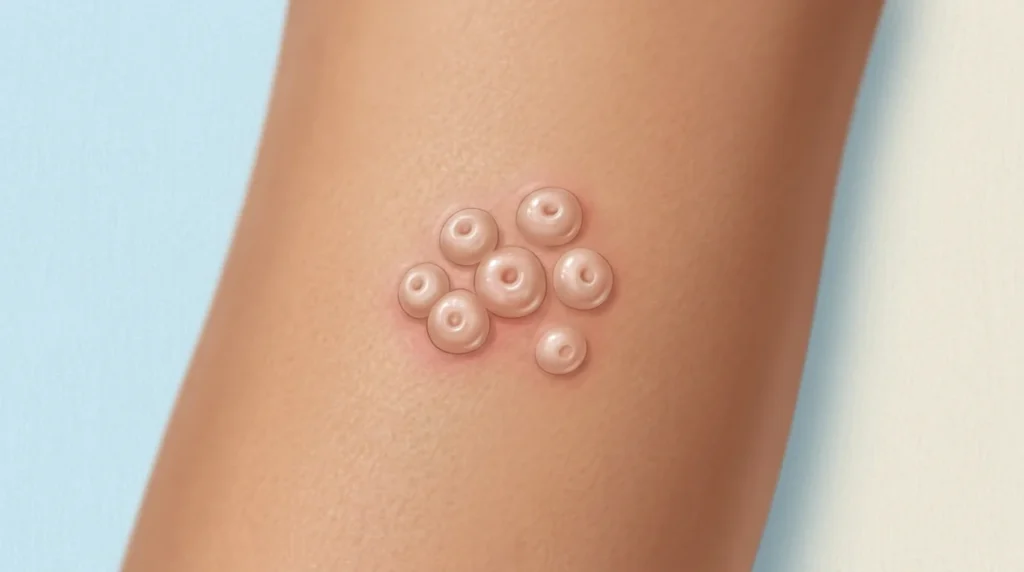
- Molluscum causes smooth, round bumps with a small dent in the center.
- Warts usually have a rough, raised surface and are caused by the human papillomavirus (HPV).
The appearance, virus, treatment, and duration differ, even though both can spread through skin contact.
Molluscum Explained
What Is Molluscum?
Molluscum contagiosum is a contagious skin infection caused by the molluscum contagiosum virus (MCV), a member of the poxvirus family.
It commonly affects:
- Children
- Athletes involved in close-contact sports
- People with eczema
- Adults through close skin contact, including sexual contact
The condition is usually harmless and often clears on its own over time.
How Molluscum Looks
Typical features include:
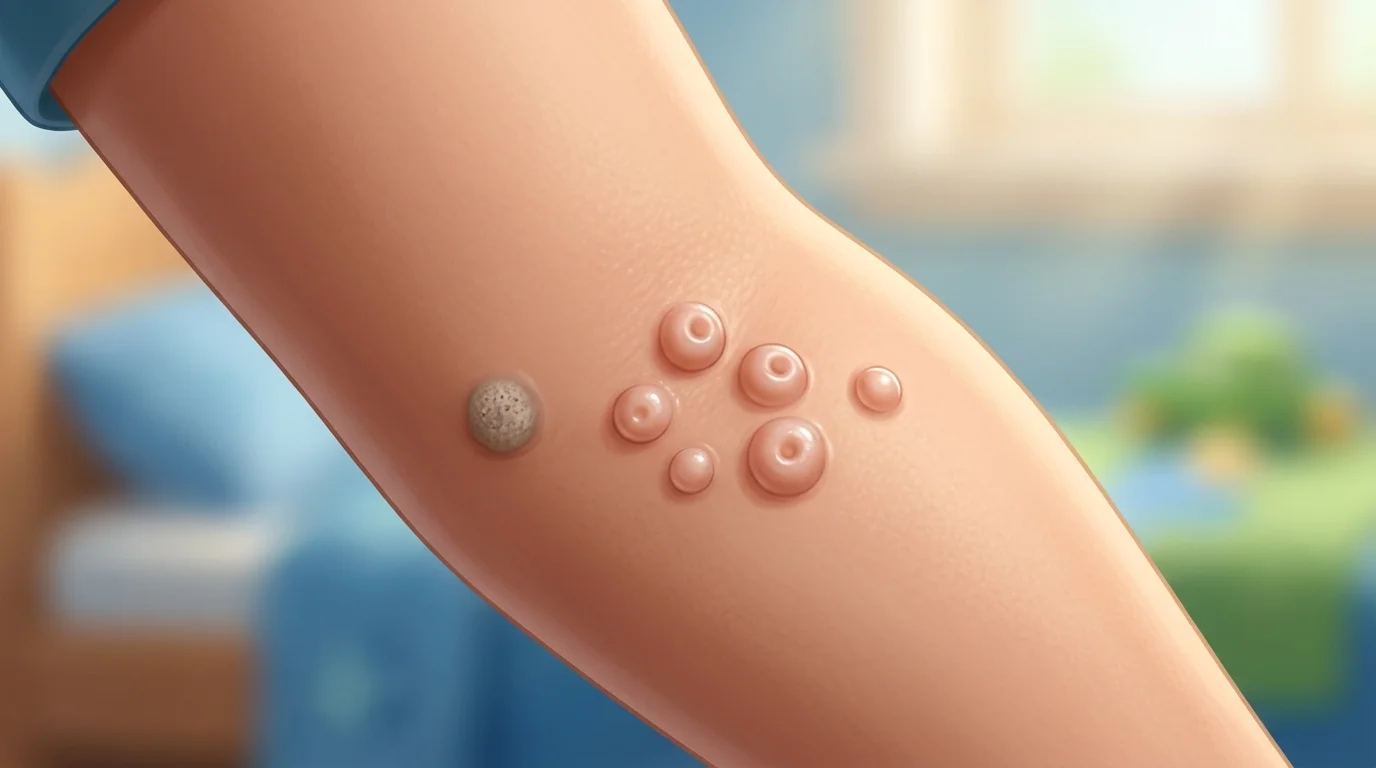
- Small, smooth bumps
- Flesh-colored, white, or pink
- Dome-shaped appearance
- Tiny indentation (dimple) in the center
- Usually painless
- May become itchy or inflamed
The bumps often appear in clusters.
Common Locations
Molluscum frequently appears on:
- Face (especially in children)
- Neck
- Arms
- Torso
- Legs
- Groin or genital area in adults
Examples
Example 1
A six-year-old develops several shiny bumps on the arm after swimming lessons.
Example 2
An adult notices smooth bumps around the lower abdomen after close skin contact.
Example 3
A child with eczema develops dozens of small, pearly bumps around irritated skin.
Key Insight
The small central dimple is one of the strongest clues that a bump is molluscum rather than a wart.
Wart Explained
What Is a Wart?
A wart is a skin growth caused by the human papillomavirus (HPV).
HPV enters the skin through tiny cuts or breaks and causes extra skin cells to grow.
There are many different types of warts.
How Warts Look
Common characteristics include:
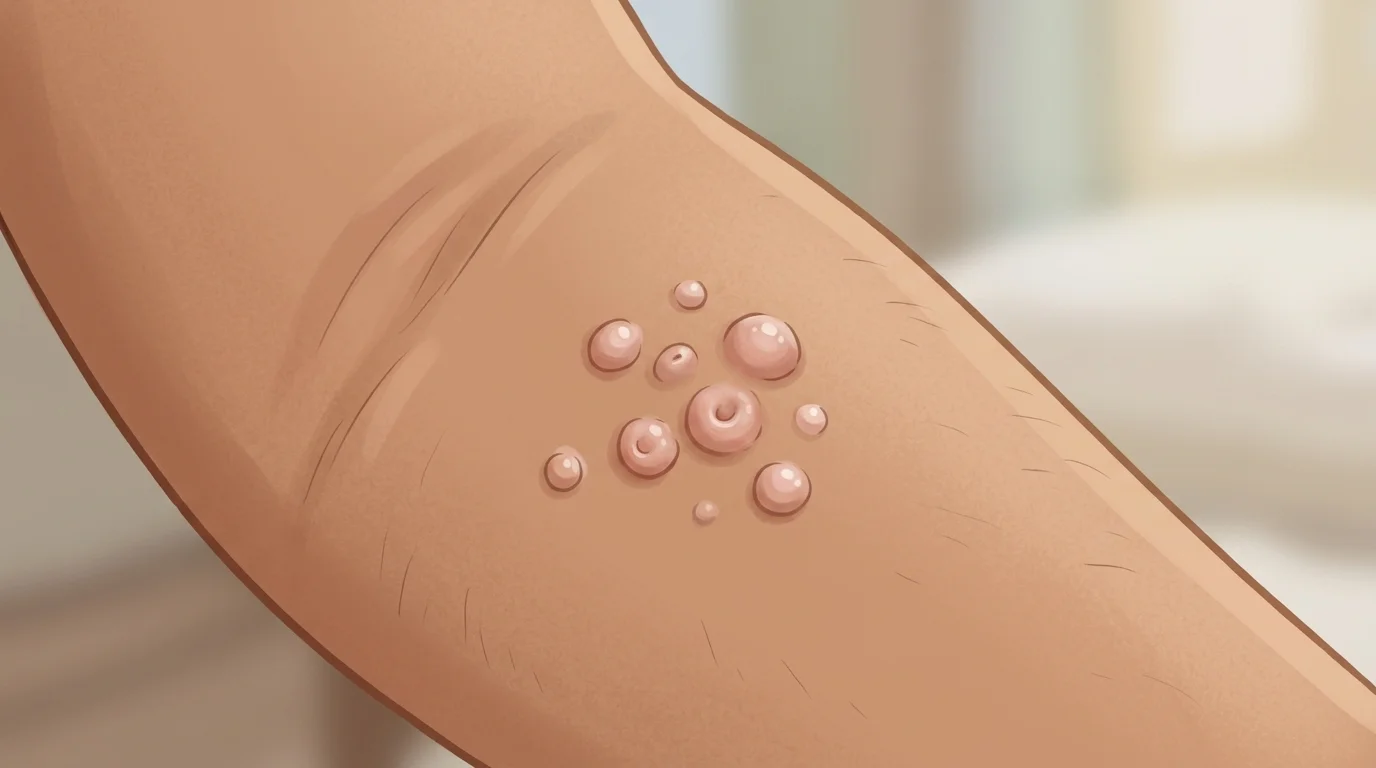
- Rough texture
- Raised surface
- Thickened skin
- Tiny black dots (clotted blood vessels)
- Often firm to the touch
Unlike molluscum, most warts do not have a central dimple.
Common Types
Common Wart
Usually found on:
- Fingers
- Hands
- Knuckles
Plantar Wart
Appears on:
- Bottom of the foot
Often painful when walking.
Flat Wart
Usually appears on:
- Face
- Arms
- Legs
These are smoother and flatter than common warts.
Filiform Wart
Found around:
- Mouth
- Nose
- Eyes
These have finger-like projections.
Examples
Example 1
A teenager develops a rough bump on the finger after biting nails.
Example 2
A runner notices painful thick skin on the sole of the foot.
Example 3
Several small flat bumps appear on the forehead.
Key Insight
A rough surface with tiny black dots usually points toward a wart.
Molluscum or Wart: Key Differences
Quick Comparison
- Cause
- Molluscum: Molluscum contagiosum virus (MCV)
- Wart: Human papillomavirus (HPV)
- Texture
- Molluscum: Smooth
- Wart: Rough
- Center
- Molluscum: Dimple present
- Wart: Usually absent
- Pain
- Molluscum: Rarely painful
- Wart: Can be painful, especially on feet
- Spread
- Both spread through skin contact.
- Treatment
- Different treatment approaches are often recommended.
Comparison Table
| Feature | Molluscum | Wart |
|---|---|---|
| Cause | Molluscum contagiosum virus | Human papillomavirus (HPV) |
| Appearance | Smooth, shiny, dome-shaped | Rough, raised, thickened |
| Center | Small dimple | No central dimple |
| Texture | Soft or smooth | Rough or grainy |
| Black dots | Rare | Common |
| Pain | Usually painless | Sometimes painful |
| Common Age | Mostly children | All age groups |
| Healing | Often clears naturally | May persist without treatment |
Real-World Usage Scenarios
Scenario 1
Parent: “My child has tiny shiny bumps with little dents.”
Doctor: “Those sound more like molluscum than warts.”
🎯 Lesson: A central dimple strongly suggests molluscum.
Scenario 2
Friend: “This bump on my finger feels rough.”
Doctor: “That’s more typical of a common wart.”
🎯 Lesson: Rough texture usually indicates a wart.
Scenario 3
Runner: “Walking hurts because of a bump on my foot.”
Doctor: “That may be a plantar wart.”
🎯 Lesson: Pain on the sole often points to a plantar wart.
Scenario 4
Parent: “The bumps are spreading after scratching.”
Doctor: “Molluscum can spread through scratching.”
🎯 Lesson: Avoid scratching either condition to reduce spread.
Scenario 5
Teenager: “I see tiny black dots inside the bump.”
Doctor: “Those black dots are common in warts.”
🎯 Lesson: Tiny black dots are a classic wart sign.
Causes and Risk Factors
Molluscum
Risk factors include:
- Young age
- Eczema
- Swimming pools and shared towels
- Contact sports
- Weakened immune system
- Close skin-to-skin contact
Warts
Risk factors include:
- Minor skin injuries
- Nail biting
- Walking barefoot in communal areas
- Weak immune response
- Direct contact with infected skin
Diagnosis
Healthcare providers usually diagnose both conditions by:
- Visual examination
- Medical history
- Skin examination
Occasionally, a skin biopsy may be needed if the diagnosis is uncertain.
Treatment Options
Molluscum Treatment
Depending on age, symptoms, and location, treatment may include:
- Watchful waiting
- Cryotherapy
- Curettage
- Prescription topical medications
- Cantharidin (applied by a healthcare professional)
Many cases resolve naturally over several months to a couple of years.
Wart Treatment
Treatment options include:
- Salicylic acid
- Cryotherapy
- Prescription medications
- Laser therapy
- Minor surgical removal
- Immunotherapy in selected cases
Treatment depends on the wart type, size, and location.
Common Mistakes
Mistake 1
Thinking every small bump is a wart.
Correction: Smooth bumps with a dimple may be molluscum.
Why it happens: Both conditions are viral and can look similar initially.
Mistake 2
Picking or scratching bumps.
Correction: This can spread the virus.
Why it happens: People mistake them for pimples.
Mistake 3
Using wart remover on every bump.
Correction: Some wart treatments can irritate molluscum lesions.
Why it happens: The bumps appear similar to the untrained eye.
Mistake 4
Ignoring spreading lesions.
Correction: New bumps may indicate continued viral spread.
Why it happens: People assume they will disappear immediately.
Mistake 5
Self-diagnosing without professional advice.
Correction: Some skin cancers and other conditions can resemble both.
Why it happens: Online images may not match individual cases.
Memory Tricks
Remember Molluscum
M = Middle Dent
Think:
Molluscum = Middle dimple.
Remember Wart
W = Weird Rough Surface
Think:
Wart = Weathered, rough skin.
Easy Shortcut
- Smooth + Dimple = Molluscum
- Rough + Black Dots = Wart
Expert Insight
Although both molluscum and warts are viral skin infections, they belong to different virus families and affect the skin in different ways.
The molluscum contagiosum virus produces smooth, pearly bumps by infecting the outer layers of the skin. Human papillomavirus (HPV), on the other hand, stimulates excess skin cell growth, creating the rough, thickened texture that characterizes warts.
This difference in biology explains why the two conditions respond differently to treatments. Some therapies that work well for warts may not be appropriate for molluscum, making an accurate diagnosis important before starting treatment.
If a skin bump changes rapidly, bleeds, becomes very painful, or doesn’t improve over time, it should be evaluated by a healthcare professional to rule out other skin conditions. molluscum or wart.