
Quick Answer
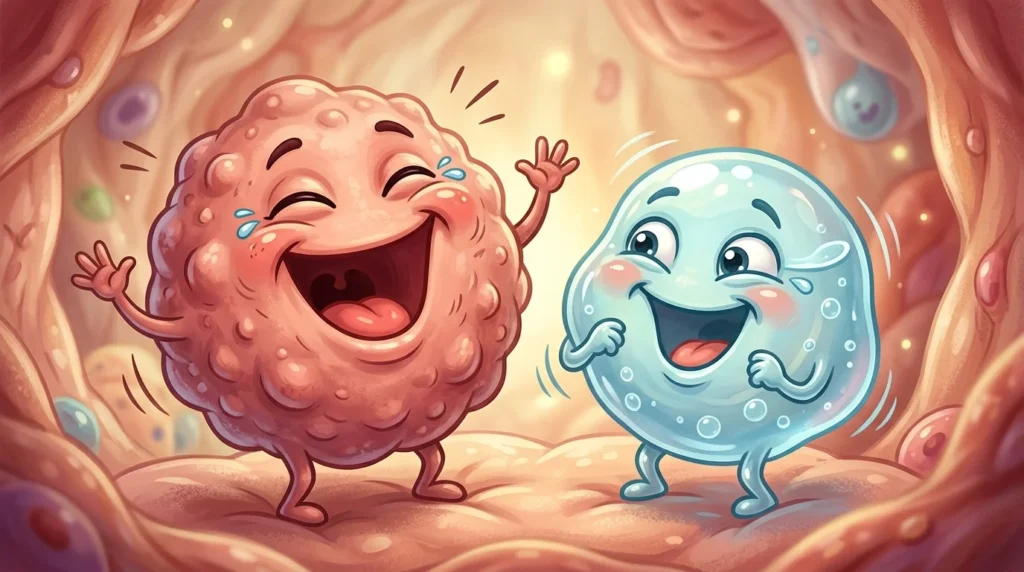
A cyst is a fluid-filled sac that can form anywhere in the body.
A fibroid is a solid, non-cancerous growth made of muscle tissue, usually found in the uterus.
Key difference:
- Cyst = fluid-filled
- Fibroid = solid tissue growth

What Is a Cyst?
A cyst is a closed sac-like structure filled with fluid, air, or semi-solid material. It can form in skin, organs, or tissues.
Common types
- Sebaceous cyst (skin)
- Ovarian cyst
- Kidney cyst
Causes
- Blocked glands
- Infections
- Hormonal changes
- Cell abnormalities
Symptoms
- Small painless lump (often)
- Pain if infected or large
- Swelling or pressure
Key insight
Most cysts are harmless, but some may grow or rupture and need treatment.

What Is a Fibroid?
A fibroid is a non-cancerous tumor made of muscle and fibrous tissue, most commonly found in the uterus.
(Clinically known as uterine fibroids)
Common types
- Intramural fibroids (inside uterine wall)
- Submucosal fibroids (inside cavity)
- Subserosal fibroids (outer uterus)
Causes
- Hormonal imbalance (estrogen & progesterone)
- Genetic factors
- Growth factors in tissue
Symptoms
- Heavy menstrual bleeding
- Pelvic pressure
- Frequent urination
- Pain during periods or intercourse
Key insight
Fibroids are solid growths—not fluid-filled—and are strongly hormone-influenced.
Cyst vs Fibroid: Key Differences
Main differences
- Cyst = fluid-filled sac
- Fibroid = solid muscle growth
- Cyst can appear anywhere
- Fibroid mainly occurs in uterus
- Cysts may come and go
- Fibroids usually grow slowly over time
- Cysts often caused by blockage or infection
- Fibroids linked to hormones
Comparison Table
| Feature | Cyst | Fibroid |
|---|---|---|
| Structure | Fluid-filled sac | Solid muscle tissue |
| Location | Anywhere in body | Mostly uterus |
| Cause | Blockage, infection, cells | Hormonal + genetic |
| Pain | Sometimes | Often (pelvic/period pain) |
| Growth | Can appear/disappear | Usually slow growth |
| Nature | Usually harmless | Benign but may cause issues |
Real-World Scenarios
Scenario 1
Doctor: You have a fluid-filled cyst in your ovary.
Patient: So it’s not a tumor?
Doctor: Correct, it’s not a fibroid.
🎯 Lesson: Cysts are fluid-based, not muscle growths.
Scenario 2
Patient: Why is my bleeding so heavy?
Doctor: You likely have uterine fibroids.
🎯 Lesson: Fibroids affect menstrual patterns.
Scenario 3
Patient: The lump came and went last year.
Doctor: That sounds like a cyst.
🎯 Lesson: Cysts can resolve on their own.
Common Mistakes
1. Thinking both are cancers
❌ Wrong assumption
✔ Both are usually benign
2. Assuming all lumps are the same
❌ Cyst = fibroid
✔ Different structure and causes
3. Self-diagnosing based on pain
Pain levels don’t reliably distinguish them.
Memory Tricks
- Cyst = “C” for “Contained fluid”
- Fibroid = “F” for “Firm mass”
Simple rule:
Fluid vs Firm
Expert Insight
Medically, the key distinction lies in tissue composition:
- Cysts arise from epithelial or blocked glandular structures that accumulate fluid.
- Fibroids originate from smooth muscle cells responding to hormonal signals.
This is why cysts can appear in multiple organs, while fibroids are strongly site-specific (especially uterine tissue). momentcyst or fibroid.