
Quick Answer
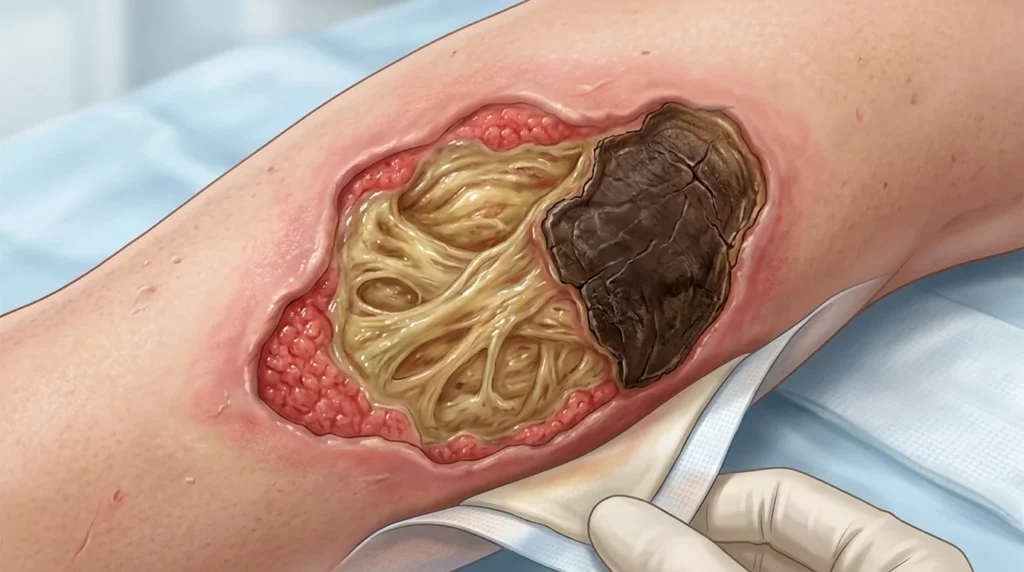
Slough is soft, moist, yellow-white or greenish dead tissue that usually indicates a wound in a sloughing (non-viable tissue) phase.
Eschar is dry, thick, leathery, dark brown or black dead tissue that is firmly attached and often indicates deeper or more severe tissue damage.
The key difference is: slough is soft and moist, while eschar is hard, dry, and leathery.
What Is Slough?
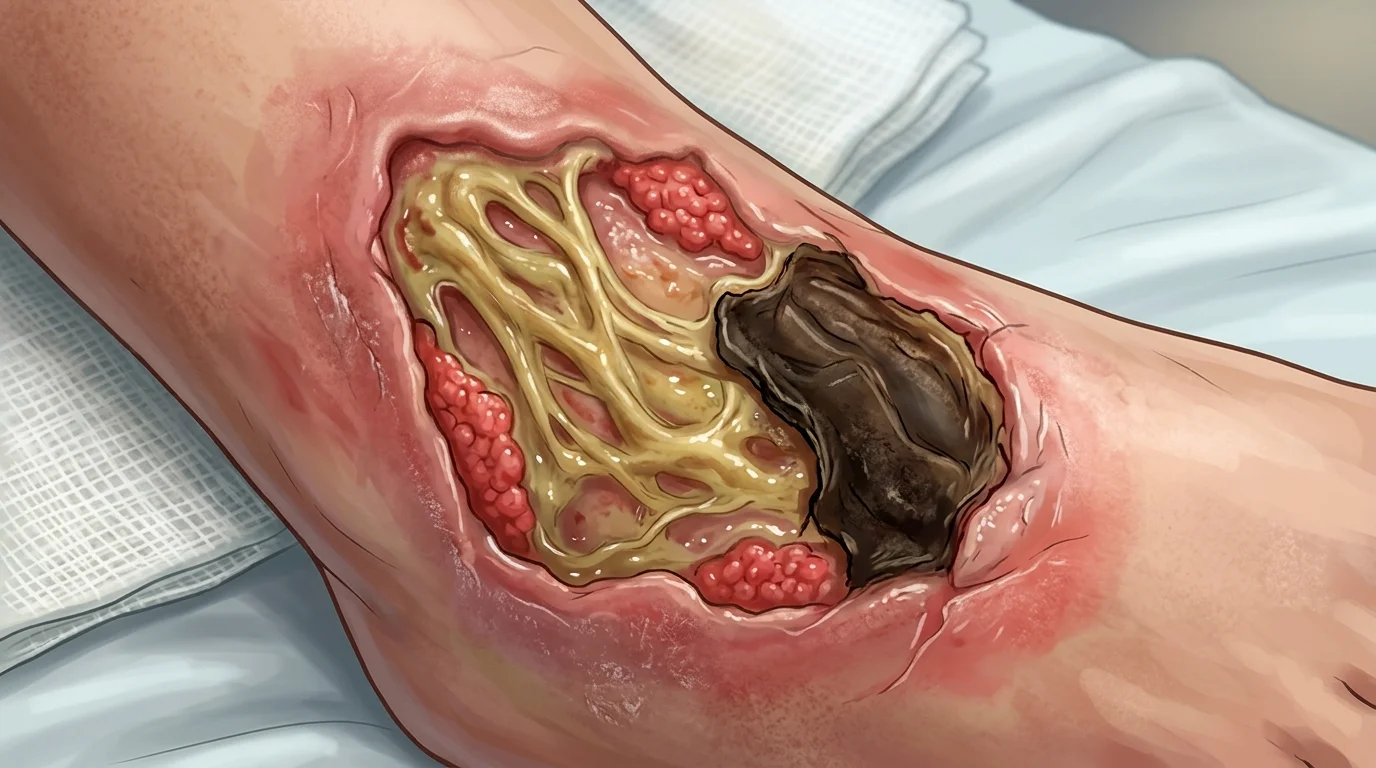
Slough is a type of devitalized (dead) tissue that forms in wounds during the inflammatory or cleaning phase of healing.
It is made up of:
- Dead white blood cells
- Bacteria
- Tissue debris
- Serous fluid
Appearance
- Yellow
- Creamy white
- Greenish
- Moist or slimy texture
Where It Appears
Slough is commonly seen in:
- Pressure ulcers (early to mid stages)
- Venous ulcers
- Infected wounds
- Chronic non-healing wounds
Examples
Example 1
A diabetic foot ulcer shows yellow, stringy tissue in the wound bed.
Example 2
A pressure sore has a moist, pale layer covering part of the wound.
Example 3
A venous leg ulcer produces thick, soft tissue with drainage.
Key Insight
Slough indicates a wound that is still biologically active but filled with non-viable tissue.
What Is Eschar?
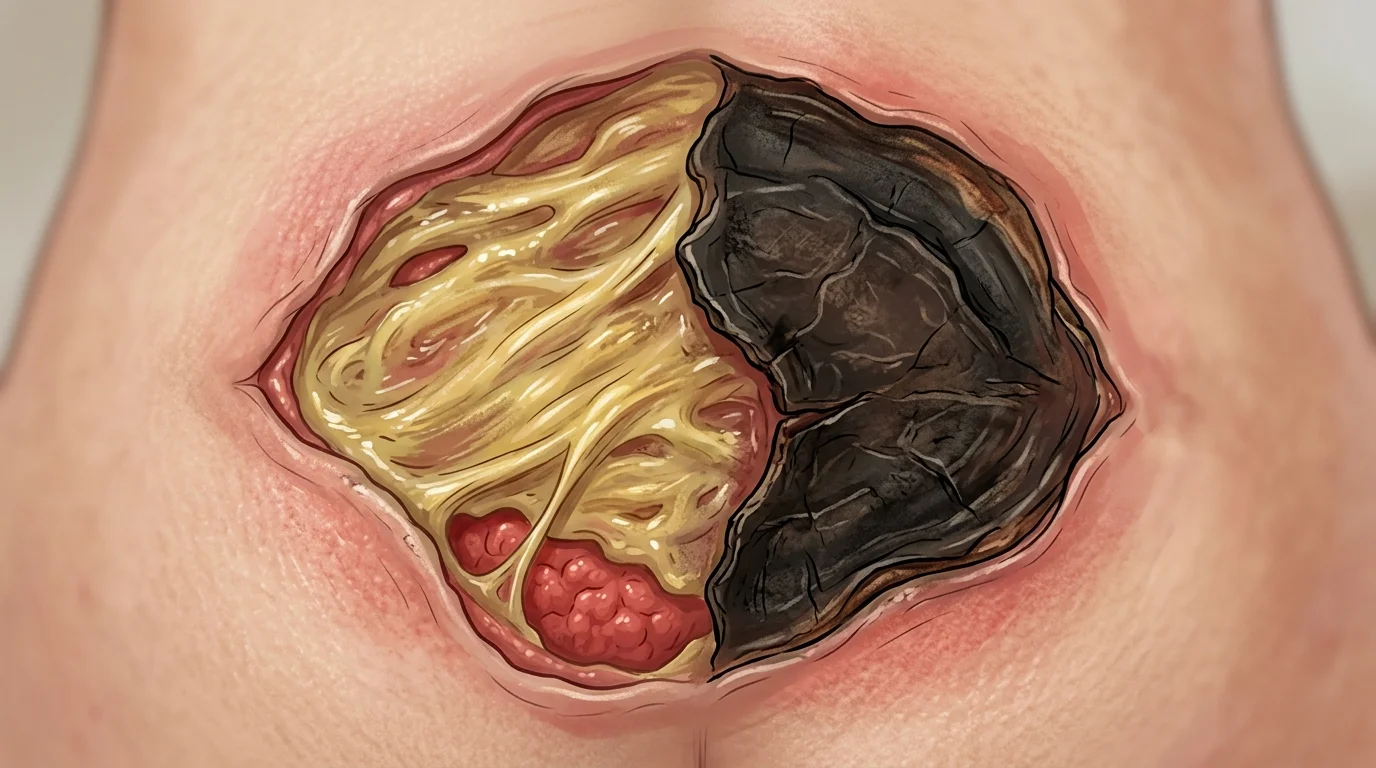
Eschar is a hard, dry, dark scab-like layer of dead tissue that forms after severe tissue damage.
It is often caused by:
- Burns (thermal, chemical, electrical)
- Severe pressure injuries
- Ischemic wounds (lack of blood supply)
Appearance
- Black or dark brown
- Dry
- Thick and leathery
- Firmly attached to wound bed
Where It Appears
Eschar is commonly seen in:
- Deep pressure injuries (Stage 3 or 4)
- Burn wounds
- Necrotic ischemic tissue
Examples
Example 1
A burn victim develops a black, leathery layer over damaged skin.
Example 2
A heel pressure injury forms a dry, hard black scab.
Example 3
A diabetic patient develops ischemic necrosis with dark tissue.
Key Insight
Eschar usually indicates deeper tissue death and more severe injury than slough.
Slough vs Eschar: Key Differences
Tissue Type
- Slough: Soft, moist necrotic tissue
- Eschar: Hard, dry necrotic tissue
Color
- Slough: Yellow, white, green
- Eschar: Black, dark brown
Texture
- Slough: Slimy or stringy
- Eschar: Leathery or crusty
Attachment
- Slough: Loosely attached
- Eschar: Firmly attached
Clinical Severity
- Slough: Moderate wound contamination or necrosis
- Eschar: Severe tissue death or full-thickness injury
Slough vs Eschar Comparison Table
| Feature | Slough | Eschar |
|---|---|---|
| Consistency | Soft / moist | Hard / dry |
| Color | Yellow, white, green | Black, brown |
| Texture | Slimy, stringy | Leathery, crusted |
| Attachment | Loose | Firm |
| Depth Indicator | Partial tissue death | Full-thickness necrosis |
| Common Cause | Infection, inflammation | Burns, ischemia, severe pressure |
| Healing Stage | Debridement phase | Protective or necrotic barrier |
Real-World Clinical Scenarios
Scenario 1
Nurse: “The wound has yellow, wet tissue.”
Doctor: “That’s slough; it needs debridement.”
🎯 Lesson: Moist yellow tissue usually indicates slough.
Scenario 2
Caregiver: “The wound is black and dry.”
Clinician: “That’s eschar, likely from ischemic damage.”
🎯 Lesson: Black, dry tissue suggests eschar.
Scenario 3
Student: “Can eschar be wiped away?”
Instructor: “No, it is firmly attached.”
🎯 Lesson: Eschar is not easily removed.
Scenario 4
Wound care note: “Yellow stringy material present.”
Assessment: Sloughing wound bed.
🎯 Lesson: Stringy = slough.
Scenario 5
Burn unit report: “Dry, leathery black eschar over injury site.”
Assessment: Full-thickness burn.
🎯 Lesson: Eschar often signals severe burns.
Common Mistakes
Mistake 1: Thinking Slough and Eschar Are the Same
Why it happens:
Both represent dead tissue.
Correction:
Slough = moist; eschar = dry and hard.
Mistake 2: Trying to Remove Eschar Immediately
Why it happens:
Assuming all dead tissue should be removed.
Correction:
Stable eschar (especially on heels) may be left intact depending on clinical guidance.
Mistake 3: Ignoring Infection Signs in Slough
Why it happens:
Focusing only on appearance.
Correction:
Slough often indicates bacterial load or inflammation.
Mistake 4: Underestimating Eschar Severity
Why it happens:
It looks like a simple scab.
Correction:
Eschar often signals deep tissue loss.
Memory Tricks
Trick 1
Slough = Slimy
Soft, wet, and messy.
Trick 2
Eschar = Extra hard
Think “E” for “Extreme dryness.”
Trick 3
Yellow vs Black Rule
- Yellow = Slough
- Black = Eschar
Expert Insight
From a wound care perspective, slough and eschar represent different stages of necrotic tissue formation.
Slough is typically associated with inflammatory processes where the body is attempting to clean a wound but has not successfully removed debris. Eschar, however, is often the result of full-thickness tissue death due to ischemia or burns, forming a protective but non-viable barrier.
Clinically, the distinction matters because treatment decisions—especially debridement—depend heavily on tissue type, wound location, and overall patient condition. Misidentification can lead to delayed healing or inappropriate intervention. slough or eschar.